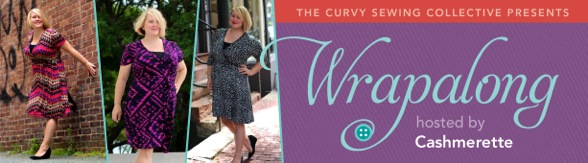
Just a quick note today: If you haven't already done so today, hop on over to the Curvy Sewing Collective, where I've written a guest post all about shopping for knits with a wrap dress project in mind:
Wrapalong: choosing your fabric (and fabric discounts!)
If you're unfamiliar with the Curvy Sewing Collective, the CSC is a collective blog from a group of gorgeous, fabulous curvy-figured sewists. Articles have a focus of sewing for a curvy figure and body positivity. I highly recommend checking them out.
Additionally, the CSC is gearing up to host a sewalong starting in a few weeks. The sewalong will be for that iconic, curve-friendly garment, the wrap dress. In conjunction with the sewalong, they've posted some great discount codes to one of my favorite online fabric stores (Gorgeous Fabrics) and a new-to-me but very enticing store, The Smuggler's Daughter.
In sewing news, I finished my HotPatterns Torque Top a few days ago but haven't taken pictures yet. It's a fun top and a fun pattern. I'll post my full review once I've gotten the top photographed. I've also started on a knit polo dress for my daughter. The dress has a contrast polo placket, and I've never done this sort of placket before. It's sort of giving me fits. I think I've figured out what my big problem is, though and am hoping that after some seam ripping, the rest will go smoothly. If the dress turns out as cute as I'm expecting, I'll be using this pattern again, and hopefully the placket will only take 1 or 2 attempts next time instead of 3 or 4.
Showing posts with label online fabric shopping. Show all posts
Thursday, September 11, 2014
Wednesday, August 27, 2014
Shopping for knits online, part 3: Rayon Jersey Knits
I intend for this to be my final post in my "shopping for knits online" series, and in this post, we'll look at a few listings for rayon jerseys from different online sources. If you're new to my blog, here are the other two posts in this series:
Now, there certainly are other types of knit fabrics that you can buy online, such as French Terry, Ponte de Roma, and now even neoprene/SCUBA double knits. I may add onto this series with a post about these fabrics later on, but as for now, I don't feel confident enough in my own ability to shop for these fabric types to write an entire post about them. However, here are a few observations that I've made based on my experience so far with these fabrics:
For me, rayon jerseys have required the most trial-and-error shopping out of any type of knit. "Mid-weight" seems to mean something different to every online retailer. This post will largely be me sharing my lessons learned with you.
If you haven't worked with rayon jersey before, be aware that this type of jersey is generally very soft and very drapey. If you're not used to working with drapey knits, rayons can be a bit more difficult to work with than more stable knits like ITY jerseys and cotton knits. On the other hand, rayons usually have an amazing drape and are great for garments with ruching details or things like cowls necklines.
I won't discuss "tissue-weight" or "layering" rayon jerseys in this post because I avoid those like the plague. Jerseys of those weights absolutely have to be lined or layered with another piece, and I'd rather not deal with them. That said, I could see them working well for lounge tops or lingerie. The "tissue weight" or "layering" red light keywords apply across all online fabric sources, as far as I'm concerned.
Enough rambling from me. Let's look at some jerseys!
11oz. rayon/lycra jersey from Emma One Sock
I'll cut to the chase, I love the 11 oz. rayon lycra jersey from Emma One Sock. To me, it's the gold standard for rayon lycra jerseys and is worth the price tag, if you've got an appropriate TNT garment to use it for.
Linda from EOS always has a ton of this fabric in stock in many, many different colors. You can reliably order and re-order from this group and always know what you're going to get.
At $18/yard, if you use 2 yards for a knit top pattern that you've already made and loved, $36 total for a top that will wash and wear well through multiple seasons seems like a good investment to me. The description for this fabric is pretty accurate. The thing to take away from it is the weight is 11oz, and if you look at the suggested uses, "pants" are one of them. This is a beefy knit. A maxi-dress made out of this will both stretch (note the 4-way stretch) and feel heavy.
I've bought and sewn with this fabric probably about a half dozen or more times over the years. I love this fabric for tops. I like it for simple knit dresses; however, I wouldn't go with any fuller of a skirt than an A-line shape for this fabric, as a dress with a full skirt will feel pretty heavy. This fabric would work great for a dress bodice in a solid color and the skirt in a lighter-weight print.
Knit print from Emma One Sock
Hint: most fabrics described as "knit prints" from EOS are rayon jerseys. Of course, you'll want to check the fabric description to be sure. Here's a fairly typical knit print (i.e. "rayon jersey") listing from EOS:
With this fabric, you're largely paying for the quality of the print. I haven't worked with this exact fabric, but I have occasionally splurged on other rayon knit prints from EOS, and her knits are generally quite a bit lighter weight and drapier than the solid-colored 11oz jersey. This listing describes this fabric as medium-lightweight, and from the similar knits that I've worked with, I would agree. I'd use this fabric in either a knit top or a drapey dress, like a Colette Myrtle.
Midweight Rayon Jersey from Gorgeous Fabrics
Moving down the price scale a little bit, here's a midweight rayon jersey from Gorgeous Fabrics:
Now, when I think of a fabric as "midweight", I usually think of a t-shirt as an example garment. I don't think that necessarily applies to rayon jerseys, and I think we'll generally be happier if we can get that association out of our heads. This fabric is described as "midweight", but the midweight rayon jerseys that I've received from Gorgeous Fabrics have definitely been on the lighter side of what I'd use for a t-shirt. They do, however, work well for drapey knit tops, which is the example pattern in this listing (the "HP Mighty Aphrodite knit top"). Another clue is that Ann hints that this jersey can be layered with other garments--to me, that's a pretty big sign post that this fabric is on the lighter side.
Super Soft Rayon Jersey from Gorgeous Fabrics
Okay, if the above fabric is a "midweight" jersey, then what's a super soft jersey?
When Ann says that a fabric is "super soft", she means it. You might buy this fabric for a top, but you'll feel it and want to use it for pajamas. I'm sure that it varies some, but my experience has been that the "super soft" jerseys run a little lighter in weight than Ann's "midweight" jerseys.
This listing doesn't contain a whole lot of clues as to the weight of the fabric, but both recommended patterns have some drape and gather details. If this fabric is the same as other "super soft" jerseys I've bought/swatched from GF, I'm not sure that I would use it for a Tiramisu. Normally, Ann's descriptions and recommendations for her fabric are spot-on, but my opinion does occasionally differ from hers once I have fabric in-hand.
Fabric.com rayon jerseys
I won't post individual listing examples for fabric.com because I haven't ordered a rayon jersey from here in a while, generally having been disappointed with how lightweight the ones that I'd ordered were. I mention them because I know that they're a popular source for inexpensive rayon jerseys among a lot of sewists. I can offer some general guidelines, though, if you're interested in ordering rayon jersey from fabric.com.
HotPatterns giveaway update
If you haven't posted a comment for the HotPatterns giveaway, you still have a few days to do so before the August 30th cut-off (PST). I'll announce the winner on Monday:
HotPatterns giveaway post
- Shopping for knits online, part 1: ITY Jersey Knits
- Shopping for knits online, part 2: Cotton Jersey Knits
Now, there certainly are other types of knit fabrics that you can buy online, such as French Terry, Ponte de Roma, and now even neoprene/SCUBA double knits. I may add onto this series with a post about these fabrics later on, but as for now, I don't feel confident enough in my own ability to shop for these fabric types to write an entire post about them. However, here are a few observations that I've made based on my experience so far with these fabrics:
- French Terry: The few pieces of French Terry that I've bought and worked with (all from Girl Charlee) have all been absolutely lovely fabrics--drapey with a nice amount of body (more body than many of the jersey knits we've discussed in this series). I love this stuff. It's held up well to washing and wearing so far, and I expect to stalk their web site and buy/stash prints and colors that I like when they get them in stock.
- Ponte de Roma: Ponte de Roma is a type of double knit fabric and is currently experiencing a lot of popularity. PdR is affordable, has a nice drape, and is often available in a wide variety of solid colors and prints. Because PdR is relatively stable, you can also often use it in a pattern that calls for a woven fabric. (A lot of people refer to this fabric as "Ponte" as a shortcut, but "Ponte" is a different fabric with less drape.) PdR is typically a blend of rayon, polyester, and spandex. Because this fabric type is a rayon-poly blend, some fabrics will pill in the wash, which is generally the biggest knock against Pdr. Generally, a blend with a higher poly content will tend to pill more than a blend with a higher rayon content, although I have read about exceptions online. Blends with higher rayon content will also tend to feel softer to the touch. Occasionally, you'll run across a PdR that's all poly and spandex with no rayon. I, personally, would probably not purchase this fabric.
- Neoprene/SCUBA knits: These are everywhere right now, often available in vibrant colors and prints. Neoprene/SCUBA is a beef-ish double knit that can be used for more structured garments. No, it does not feel like a wetsuit. I've purchased three cuts of this fabric from three different sources but have not sewn any of it yet (although I plan to do so soon).
- The first cut that I ordered was an inexpensive solid purple cut that I bought on sale from FabricMart. Honestly, this fabric feels "icky" for a lack of a better word. Luckily, I only bought one yard of it to make a Mabel pencil skirt, but I can't seem to bring myself to actually work with this cut. Maybe it'll feel better after washing, but right now, I'm leaning towards writing off my $6 investment.
- The second cut that I ordered was a cut from Girl Charlee, and it feels So. Much. Nicer. than the stuff from FabricMart. This cut was from the big lot of SCUBA fabric that they got in within the last month or so. It's beefy and soft and stable, and I think that it will work well as an unlined bomber jacket, which is what I'd originally purchased it for.
- The third cut that I ordered was from Gorgeous Fabrics. They've gotten a lot of neoprene in lately, too, and I got sucked in by a cool print. This cut was the most expensive, and not surprisingly, feels the nicest out of the bunch. I'm planning to do a "wearable muslin" in the Girl Charlee fabric and make my "real" garment out of the stuff from Gorgeous Fabrics.
For me, rayon jerseys have required the most trial-and-error shopping out of any type of knit. "Mid-weight" seems to mean something different to every online retailer. This post will largely be me sharing my lessons learned with you.
If you haven't worked with rayon jersey before, be aware that this type of jersey is generally very soft and very drapey. If you're not used to working with drapey knits, rayons can be a bit more difficult to work with than more stable knits like ITY jerseys and cotton knits. On the other hand, rayons usually have an amazing drape and are great for garments with ruching details or things like cowls necklines.
I won't discuss "tissue-weight" or "layering" rayon jerseys in this post because I avoid those like the plague. Jerseys of those weights absolutely have to be lined or layered with another piece, and I'd rather not deal with them. That said, I could see them working well for lounge tops or lingerie. The "tissue weight" or "layering" red light keywords apply across all online fabric sources, as far as I'm concerned.
Enough rambling from me. Let's look at some jerseys!
11oz. rayon/lycra jersey from Emma One Sock
I'll cut to the chase, I love the 11 oz. rayon lycra jersey from Emma One Sock. To me, it's the gold standard for rayon lycra jerseys and is worth the price tag, if you've got an appropriate TNT garment to use it for.
![]() |
| Emma One Sock 11 oz rayon jersey |
Linda from EOS always has a ton of this fabric in stock in many, many different colors. You can reliably order and re-order from this group and always know what you're going to get.
At $18/yard, if you use 2 yards for a knit top pattern that you've already made and loved, $36 total for a top that will wash and wear well through multiple seasons seems like a good investment to me. The description for this fabric is pretty accurate. The thing to take away from it is the weight is 11oz, and if you look at the suggested uses, "pants" are one of them. This is a beefy knit. A maxi-dress made out of this will both stretch (note the 4-way stretch) and feel heavy.
I've bought and sewn with this fabric probably about a half dozen or more times over the years. I love this fabric for tops. I like it for simple knit dresses; however, I wouldn't go with any fuller of a skirt than an A-line shape for this fabric, as a dress with a full skirt will feel pretty heavy. This fabric would work great for a dress bodice in a solid color and the skirt in a lighter-weight print.
Knit print from Emma One Sock
Hint: most fabrics described as "knit prints" from EOS are rayon jerseys. Of course, you'll want to check the fabric description to be sure. Here's a fairly typical knit print (i.e. "rayon jersey") listing from EOS:
![]() |
| Knit Print from EOS |
Midweight Rayon Jersey from Gorgeous Fabrics
Moving down the price scale a little bit, here's a midweight rayon jersey from Gorgeous Fabrics:
![]() |
| Midweight Rayon Jersey from Gorgeous Fabrics |
Super Soft Rayon Jersey from Gorgeous Fabrics
Okay, if the above fabric is a "midweight" jersey, then what's a super soft jersey?
![]() |
| "Super soft" rayon jersey from Gorgeous Fabrics |
This listing doesn't contain a whole lot of clues as to the weight of the fabric, but both recommended patterns have some drape and gather details. If this fabric is the same as other "super soft" jerseys I've bought/swatched from GF, I'm not sure that I would use it for a Tiramisu. Normally, Ann's descriptions and recommendations for her fabric are spot-on, but my opinion does occasionally differ from hers once I have fabric in-hand.
Fabric.com rayon jerseys
I won't post individual listing examples for fabric.com because I haven't ordered a rayon jersey from here in a while, generally having been disappointed with how lightweight the ones that I'd ordered were. I mention them because I know that they're a popular source for inexpensive rayon jerseys among a lot of sewists. I can offer some general guidelines, though, if you're interested in ordering rayon jersey from fabric.com.
- "Tissue": You'll see a lot of fabric.com jerseys use this word in their description. Tissue weight jersey is EXTREMELY lightweight. As I mentioned in my intro, I avoid anything of this weight like the plague.
- "Slub": The word "slub" refers to little runs and "flaws" intentionally knitted into the fabric. Slub doesn't mean anything weight-wise. Pay attention to the fabric description for that.
- "Lightweight": As with ITY jerseys, when fabric.com says that something is lightweight, they mean it. "Lightweight" generally isn't as lightweight as "tissue" weight, but it's still a weight that I avoid.
- "Dakota": Dakota is a manufacturer brand name. I've seen the Dakota line fabrics on other sites listed for significantly more than what fabric.com charges. If I were going to order a rayon jersey from fabric.com, I'd look for the Dakota name and stick with that. In my experience, when fabric.com mentions a manufacturer's brand name, it's nearly always a fabric of at least decent quality.
HotPatterns giveaway update
If you haven't posted a comment for the HotPatterns giveaway, you still have a few days to do so before the August 30th cut-off (PST). I'll announce the winner on Monday:
HotPatterns giveaway post
Thursday, August 21, 2014
Shopping for knits online, part 2: Cotton Jersey Knits
I suspect that this is the post that many of you have been waiting for: a post on how to decipher the listings for the various cotton jersey fabrics that are available from Girl Charlee. Cotton jerseys can be surprisingly difficult to find online, and Girl Charlee carries a ton of them in their store, nearly all with cute prints and current colors. However, the weight, stretch factor, and general quality can vary a lot from Girl Charlee, which is kind of the elephant in the room when talking about shopping for cotton knits online. While you can certainly find cotton knits from other sources, I don't know of any other online sources who carry nearly the number of cute prints and variety of colors that Girl Charlee does.
This post is absolutely not intended to be a slam at them; I'm a regular customer there and have generally been happy with my purchases. I have learned, though, not to always be tempted by a really cute print; with their listings, you absolutely need to pay attention to the details so that you're not surprised when your order arrives on your doorstep.
Unlike the FabricMart and Fabric.com listings that I dissected in Shopping for knits online, part 1: ITY Jersey Knits, I have actually purchased the fabrics that we'll be looking at in the rest of this post, so I'll be able to tell you how these listings translate to "real life".
A note about pilling, fade, and pre-washing
I've seen numerous online reports about fabrics from Girl Charlee and other sources pilling, fading, or having dye run after numerous washes. Jenny from Cashmerette even ran into an issue where dye was rubbing off onto her hands and lining fabric as she worked with it. Unfortunately, I don't know how to protect yourself against these issues when shopping for fabric anywhere--whether it be online or in a brick and mortar store. I've run into these issues (except for the dye rub off) with fabrics from a number of sources, myself. I do have one Girl Charlee print that I suspect will probably fade after a number of washes, but most of my purchases from there have held up pretty well. I do know that knits printed onto cotton knits and cotton knit blends will be more susceptible to fade, in general than say, an ITY knit. I think that many of us have read stories of pricey fabrics from Spoonflower fading after a few washes, so it's a problem that runs across all price points. I know that increased poly content in rayon blends can contribute to pilling in rayon knits, so that's something else to consider.
I've also found many of Girl Charlee's prints to feel a bit "stiff" upon first touch. I have found, however, that most of them soften up very nicely after a wash or two. If you're disappointed by the hand/feel of a fabric that you've just ordered, try pre-washing it and drying it before making your final judgment.
Making sense of knit weights
Some web sites (including Girl Charlee) list a weight by oz for each fabric. Unfortunately, these numbers are meaningless if you're new to ordering knits online. Through trial-and-error and many online purchases, I've developed my own categorization of knits by weight. Your mileage may vary, but this is what I go by when I see weights listed in oz on a fabric listing:
Cotton Jersey Blend Fabric
Most of the fabrics in Girl Charlee's Exclusive line are listed as "cotton jersey blends". But what does that mean? This bird print is a good example of this type of fabric:
"Blend" in this case means a cotton-poly blend. If you look at the listed fabric content, this fabric is nearly half poly. This fabric contains no lycra. What that means is that any stretch in this fabric is mechanical, so this fabric probably wouldn't be a good choice for a pattern with negative ease. 30% stretch isn't very much stretch for a knit, anyway. A high poly content in rayon blends also can contribute to pilling in the wash; however, I've made a few things from GC's cotton jersey blends and haven't noticed any major pilling yet.
Take a look at the scale. 2" by 2" is not a small bird. It's easy to overlook the rulers on fabric listings, but you need to pay attention to them if scale-of-print is a concern. Many of the cute animal prints (and by that, I mean birds, foxes, and deer) on Girl Charlee are of a similar large-ish scale. This scale doesn't make the fabric unusable by any means, but it will make you think twice about what pattern to use with it.
If I was looking for a pattern for this fabric, I'd look at something like a loose-fitting batwing top. You won't need much stretch for that type of pattern, and it won't have a lot of seamlines to break up the print. Personally, I actually really like this line for kids' clothes for Eva. A cute dress with animals on it for under $7? You can't beat that.
One final thing to point out for this listing is that they have over 250 yards available. This print isn't selling out any time soon. If in doubt, order a swatch, then wash the swatch and see what you think before you order.
Solid Cotton Spandex Knit
Girl Charlee's "solid cotton spandex knit" fabric is dyed, rather than printed, so it has a different feel from their printed cotton spandex knits.
The biggest two differences between this fabric and the one above it is that this fabric is beefier and contains spandex and no poly.
I like this fabric a lot for inexpensive t-shirts and knit dresses. I used this exact fabric for one of my Monetas, and while I've seen some slight fading in the wash (I wash my handmade clothes on cold/delicate), it hasn't been too bad. 10oz is a nice weight for a lot of different types of garments.
With 60% stretch horizontally (around your body) and 30% stretch vertically, if you use this fabric in a dress, note that the bodice will likely stretch and be pulled down by the weight of your skirt. This isn't a bad thing, but it's something to be aware of when figuring out where your waist seam will hit you and how long your skirt hem will be.
Cotton Spandex Blend Knit Fabric
If the first two fabrics weren't named crypically enough, this one is even a bit more of a head-scratcher. Girl Charlee will often have a small amount of rayon blended in with the cotton-spandex jerseys that they use for their print fabrics. This fabric is a good example of that:
As is often the case with knits with rayon, this fabric is a bit on the lighter weight side--7.5 oz. The weight for GC's cotton spandex prints can vary a bit, so definitely take a look at that number before getting your heart set on a certain pattern for a given fabric.
Being a cotton rayon spandex blend, you can expect this fabric to be very soft. (I can confirm that it is, indeed, very soft.) Think "secret pajamas" when you think of the softness/comfort level for this fabric.
Since this fabric has 50% stretch horizontally and 15% stretch vertically, you could use this fabric for a pattern with negative ease. Like the other cotton spandex fabric, if you used this for a dress, it will stretch in the vertical direction, as well.
I bought a yard of this fabric in a different colorway to make a dress for my daughter, and while it'll be fine for a girls' dress, if I were using it for a woman's dress, I'd look at patterns like Colette's Myrtle, or a flowy maxi-dress.
This post doesn't cover every single variation on the cotton jerseys at Girl Charlee, but it should give you an idea of what to look for and give you a better idea of what you'll be getting if you order fabric from this site.
This post is absolutely not intended to be a slam at them; I'm a regular customer there and have generally been happy with my purchases. I have learned, though, not to always be tempted by a really cute print; with their listings, you absolutely need to pay attention to the details so that you're not surprised when your order arrives on your doorstep.
Unlike the FabricMart and Fabric.com listings that I dissected in Shopping for knits online, part 1: ITY Jersey Knits, I have actually purchased the fabrics that we'll be looking at in the rest of this post, so I'll be able to tell you how these listings translate to "real life".
A note about pilling, fade, and pre-washing
I've seen numerous online reports about fabrics from Girl Charlee and other sources pilling, fading, or having dye run after numerous washes. Jenny from Cashmerette even ran into an issue where dye was rubbing off onto her hands and lining fabric as she worked with it. Unfortunately, I don't know how to protect yourself against these issues when shopping for fabric anywhere--whether it be online or in a brick and mortar store. I've run into these issues (except for the dye rub off) with fabrics from a number of sources, myself. I do have one Girl Charlee print that I suspect will probably fade after a number of washes, but most of my purchases from there have held up pretty well. I do know that knits printed onto cotton knits and cotton knit blends will be more susceptible to fade, in general than say, an ITY knit. I think that many of us have read stories of pricey fabrics from Spoonflower fading after a few washes, so it's a problem that runs across all price points. I know that increased poly content in rayon blends can contribute to pilling in rayon knits, so that's something else to consider.
I've also found many of Girl Charlee's prints to feel a bit "stiff" upon first touch. I have found, however, that most of them soften up very nicely after a wash or two. If you're disappointed by the hand/feel of a fabric that you've just ordered, try pre-washing it and drying it before making your final judgment.
Making sense of knit weights
Some web sites (including Girl Charlee) list a weight by oz for each fabric. Unfortunately, these numbers are meaningless if you're new to ordering knits online. Through trial-and-error and many online purchases, I've developed my own categorization of knits by weight. Your mileage may vary, but this is what I go by when I see weights listed in oz on a fabric listing:
- Less than 7 oz: Anything under 7 oz is a lightweight knit. I would avoid anything in this range unless you wanted to layer or line the garment that you planned to make.
- 7-8 oz: light to medium weight, good for a top that needs a lot of drape or a flowy skirt (either lined or unlined, if the fabric is opaque). For example, a cowl top made from this weight of fabric will drape nicely. I would not personally use this weight for a wrap dress or for a simple knit top--a weight this light will be prone to showing lumps and bumps. Girl Charlee knits of this weight on a white background will be a bit sheer, as well.
- 8-10 oz: A true medium weight. I find this weight range to be the most "multi-use". This weight works well for a variety of knit tops and dresses. I made both of my Monetas from knits in this weight range.
- 10 oz and up: Anything over 10 oz is a "beefy" knit to me. I like this weight for plain t-shirts and other tops without gathering or ruching. This weight will not cling to lumps and bumps (unless your top/dress/skirt is tight). Beefy knits also work well for the bodices of knit dresses, but if you made an entire dress out of a knit this beefy, the dress might feel a bit "heavy".
- Cotton Jersey Blend
- Cotton Spandex Knit
- Cotton Spandex Blend (usually printed fabrics)
Cotton Jersey Blend Fabric
Most of the fabrics in Girl Charlee's Exclusive line are listed as "cotton jersey blends". But what does that mean? This bird print is a good example of this type of fabric:
![]() |
| Cotton Jersey Blend fabric |
Take a look at the scale. 2" by 2" is not a small bird. It's easy to overlook the rulers on fabric listings, but you need to pay attention to them if scale-of-print is a concern. Many of the cute animal prints (and by that, I mean birds, foxes, and deer) on Girl Charlee are of a similar large-ish scale. This scale doesn't make the fabric unusable by any means, but it will make you think twice about what pattern to use with it.
If I was looking for a pattern for this fabric, I'd look at something like a loose-fitting batwing top. You won't need much stretch for that type of pattern, and it won't have a lot of seamlines to break up the print. Personally, I actually really like this line for kids' clothes for Eva. A cute dress with animals on it for under $7? You can't beat that.
One final thing to point out for this listing is that they have over 250 yards available. This print isn't selling out any time soon. If in doubt, order a swatch, then wash the swatch and see what you think before you order.
Solid Cotton Spandex Knit
Girl Charlee's "solid cotton spandex knit" fabric is dyed, rather than printed, so it has a different feel from their printed cotton spandex knits.
![]() |
| Solid Cotton Spandex jersey knit |
The biggest two differences between this fabric and the one above it is that this fabric is beefier and contains spandex and no poly.
I like this fabric a lot for inexpensive t-shirts and knit dresses. I used this exact fabric for one of my Monetas, and while I've seen some slight fading in the wash (I wash my handmade clothes on cold/delicate), it hasn't been too bad. 10oz is a nice weight for a lot of different types of garments.
With 60% stretch horizontally (around your body) and 30% stretch vertically, if you use this fabric in a dress, note that the bodice will likely stretch and be pulled down by the weight of your skirt. This isn't a bad thing, but it's something to be aware of when figuring out where your waist seam will hit you and how long your skirt hem will be.
Cotton Spandex Blend Knit Fabric
If the first two fabrics weren't named crypically enough, this one is even a bit more of a head-scratcher. Girl Charlee will often have a small amount of rayon blended in with the cotton-spandex jerseys that they use for their print fabrics. This fabric is a good example of that:
As is often the case with knits with rayon, this fabric is a bit on the lighter weight side--7.5 oz. The weight for GC's cotton spandex prints can vary a bit, so definitely take a look at that number before getting your heart set on a certain pattern for a given fabric.
Being a cotton rayon spandex blend, you can expect this fabric to be very soft. (I can confirm that it is, indeed, very soft.) Think "secret pajamas" when you think of the softness/comfort level for this fabric.
Since this fabric has 50% stretch horizontally and 15% stretch vertically, you could use this fabric for a pattern with negative ease. Like the other cotton spandex fabric, if you used this for a dress, it will stretch in the vertical direction, as well.
I bought a yard of this fabric in a different colorway to make a dress for my daughter, and while it'll be fine for a girls' dress, if I were using it for a woman's dress, I'd look at patterns like Colette's Myrtle, or a flowy maxi-dress.
This post doesn't cover every single variation on the cotton jerseys at Girl Charlee, but it should give you an idea of what to look for and give you a better idea of what you'll be getting if you order fabric from this site.
Labels:
2014,
girl charlee,
online fabric shopping,
sewing
Thursday, August 14, 2014
Shopping for knits online, part 1: ITY Jersey Knits
Let's talk about [knits], baby
Let's talk about you and me
Let's talk about all the good things
And the bad things that may be
Let's talk about you and me
Let's talk about all the good things
And the bad things that may be
If you follow my blog, you know that I sew with knits a LOT. I also buy most of my knits online. While we have some wonder fabric stores for sewing woven garments here in Seattle, the selection for knits isn't all that great. Of course, there are exceptions, but by and large, I buy my wovens from local shops and knits online. Like everyone else, I do occasionally end up with a lemon that gets relegated to Future Muslin status, but for the most part, I'm usually pretty happy with my purchases. Granted, it took me a number of years and a lot of trial-and-error to get to this point, but I think that I've learned enough about online knit fabric listings to get a feel for what to look for and what to avoid.
In this series of posts, we'll compare online listings for similar fabrics, and I'll point out the characteristics that I zero in on to decide whether or not a particular knit is appropriate for the project that I have in mind. For now, I'll focus on ITY jersey knits, which are the knits most commonly used in knit tops and dresses. (I'll save other types of knits, like cotton jerseys, rayon jerseys, ponte knits, for future posts in this series.) I know how easy it is to get suckered by a cute print, but you won't be happy with your purchase if the fabric isn't right for your project.
To start off, I always focus on four things in a knit listing:
- Fabric content (rayon, cotton, silk, poly/ITY?)
- Amount of spandex and/or stretch?
- Weight (can be listed in general terms like "light to medium weight" or actually give a weight in oz)
- Scale of the print, if it's a print (and not solid) fabric
- Price (of course--and keeping in mind that you usually get what you pay for).
Disclaimer: I do not own and have not felt any of the fabrics discussed in this post. I'm simply giving my impressions and analysis from reading the listings.
Let's start, shall we?
Poly ITY jersey Basics
Many of the fun, vibrant prints that we see in other people's blog posts and pattern reviews are ITY (Interlock Twist Yarn) jerseys, which is a term that has to do with the way that the fabic is knitted. I've found that ITY jerseys typically (but not always) have the following characteristics:
- Poly-lycra blend
- Have a decent amount of stretch (but not too much)
- Typically have vibrant or geometric prints
- Don't usually fade in the wash
- Usually mid-range on the knit stability scale (where a Ponte knit would be very stable and a lightweight rayon-lycra would be very slippery)
- Skim over lumps and bumps
Example 1: ITY jersey from Gorgeous Fabrics
To start, let's look at a fairly typical ITY jersey listed on Gorgeous Fabrics:
![]() |
| ITY jersey on Gorgeous Fabrics |
- This listing is a poly-lycra blend with 6% lycra--that's a pretty decent amount of lycra, and this fabric has 60% cross-wise stretch. You could certainly use this fabric with a pattern that called for negative ease; the print would also help camouflage any lumps and bumps revealed by said negative ease.
- Now, Ann doesn't usually list fabric weight or give an indication of fabric weight in her listings. However, she does recommend example patterns that would be a good match for her fabrics. Pay attention to these; Ann is great at matching fabrics with patterns. In this case, the two recommended fabrics are for a semi-fitted dress with a fitted waist (New Look 6001) and a sarong. There are darts in this pattern and a little bit of ruching--you wouldn't want a really lightweight, floaty jersey for this dress. It should work well for a border print like this fabric. So, even assuming that you're planning to make something other than New Look 6001 with this fabric, the example should give some hints as to what patterns will work well with it.

New Look 6001
- For this fabric, Ann included a ruler in the main listing feature. You can see pretty easily that this print has quite a large scale. If you want to produce a RTW-looking garment, you wouldn't use a print of this scale for a dress or skirt and not for a top.
- The last thing to consider here is the price: $12/yard, which is a bit pricey for many of us, but the price also gives you a clue that this probably isn't going to be a flimsy, lightweight fabric.
Now, let's look at an ITY jersey from FabricMart. FabricMart generally has lower prices than Gorgeous Fabrics, but their quality is a bit more of a crapshoot. You can score a fantastic deal from FabricMart, but you also occasionally receive fabric that has you scratching your head, wondering if you can use it for anything other than a muslin. In any case, here's a pretty typical ITY jersey from this FabricMart:
![]() |
| ITY jersey from FabricMart |
- Right off the bat, you can see that the price for this fabric is just over half the cost of the Gorgeous Fabrics listing.
- The poly-lycra content is nearly the same as the Gorgeous Fabric listing. This listing doesn't mention stretch percentage, but at 5% lycra, this fabric will still have pretty good stretch and recovery. You could theoretically use for a pattern with negative ease.
- The "weight" guidelines would sway me, personally, from using this fabric for something with negative ease, however. In two different fields for this fabric, we see the words "Light" and "Lightweight". Recommended uses include scarves, among other lightweight and often floaty garments.
- For scale, if you click one of the supplemental pictures for this listing, you can see the scale of the print relative to a US penny. Like the Gorgeous Fabrics listing, this fabric also has a fairly large scale print.

US penny for scale reference - Taking all of these clues together, I'd look at ordering this fabric as an educated gamble, if I had the right project picked out for it. This fabric would probably be fine for a dress that calls for a lightweight knit, like a Myrtle or for a flowing maxi-dress or maxi-skirt. I'd also be mentally prepared to possibly need to line a skirt/skirt portion with a tricot or bathing suit lining.
Example 3: ITY jersey from Fabric.com
Here's another lightweight ITY jersey, this time from fabric.com:
![]() |
| Lightweight ITY jersey from fabric.com |
- At $5.98/yard, this is another inexpensive knit.
- Scale-wise, it look like the stripes on this fabric are about 2-3" wide, which you can estimate from the ruler in the picture. Those wide stripes would probably have a pretty large impact on what projects you'd find this fabric suitable for. On the other hand, with the dot and mini-stripe patterns, this will probably have a more flattering effect for most of us than if we draped solid-colored stripes of the same size across our bodies.
- The real deal-breaker for me, though, if I was looking at this fabric is that fabric.com lists this as "lightweight" in several places. When fabric.com describes something as "lightweight", they really mean it. (I've learned this from experience.) Be prepared to layer or line this fabric in whatever you use it for.
Now, here's another example from fabric.com, but this ITY jersey costs twice as much as the previous example and is listed as "medium weight", instead of lightweight. I would suspect that this fabric is close to being comparable to the Gorgeous Fabrics listing.
![]() |
| Medium weight ITY jersey from fabric.com |
- Like the Gorgeous Fabric listing, this fabric has a 6% lycra content. The Description mentions 40% stretch on grain. That's not a huge amount of stretch for an ITY.
- Another clue that this fabric is a little higher quality than the other fabric.com example is that this fabric has a name-brand manufacturer--"Brazil". Even if you're not familiar with the brand itself, I've found that fabric.com typically lists brand names for higher quality fabrics.
- If your eyes have stopped hurting from looking at the photo, you can see that a ruler indicates the scale in this photo. This print is smaller scale than some of the others that we've looked at.
- The listing uses the word "medium" in several places. This fabric is going to have more body than the other, less-expensive listings.
- I'd look at using a fabric like this in a dress like the New Look dress in the first example, or a wrap dress. A skirt would be a very good option for this print, unless you want an optical illusion right next to your face. (Who knows, maybe you do?)
Subscribe to:
Posts (Atom)


